Filters
Product Search

    Secure Checkout
    Your Shopping Cart Is Empty

    Secure Checkout

    SKU: ICE840WRS

    OSD ICE840WRS8" 150W Weather Resistant Outdoor In-Ceiling Speaker w/ Built-in Crossover, Pair

    Purchase 8" Outdoor In-Ceiling Speaker Pair 150W, Weather Resistant for High Moisture Applications
    • Outdoor Speaker Depot SKU: ICE840WRS ice840wrs-inceiling-weather-resistant-speaker
    • In Stock

      $141.69

    • Countdown Truck
      FREE Delivery by ,
      Order within hours and minutes
      Change Shipping Zip ? $50+ Free Shipping (Exceptions Apply)
      More Delivery Options

    Lifetime Tech Support

    Guarantee

    Lifetime Tech Support

    This 8-inch in-ceiling, weather-resistant speaker pair is great for high-humidity areas, including outdoor patios, bathrooms and laundry rooms. Great for covered porches patios! With high power handling and an 8-inch polypropylene woofer in each, these speakers deliver superior sound that covers large spaces. With swivel tweeter adjustment, you can easily create sweet spot for your listening area. Better crossover, tweeter and woofer materials add sound quality. The aluminum grill cover is rust-resistant for wet application.These weather-resistant indoor/ outdoor in-ceiling speakers work well with a CL3 in-wall rated speaker wire, which is designed to run inside walls. 

    Pivoting Titanium Dome Tweeter
    The job of the tweeter is to deliver the higher frequencies of music and soundtracks. The tweeter is also adjustable, meaning it can be aimed toward the listening area. This can make a big difference in sound quality especially for dialog and higher frequencies.

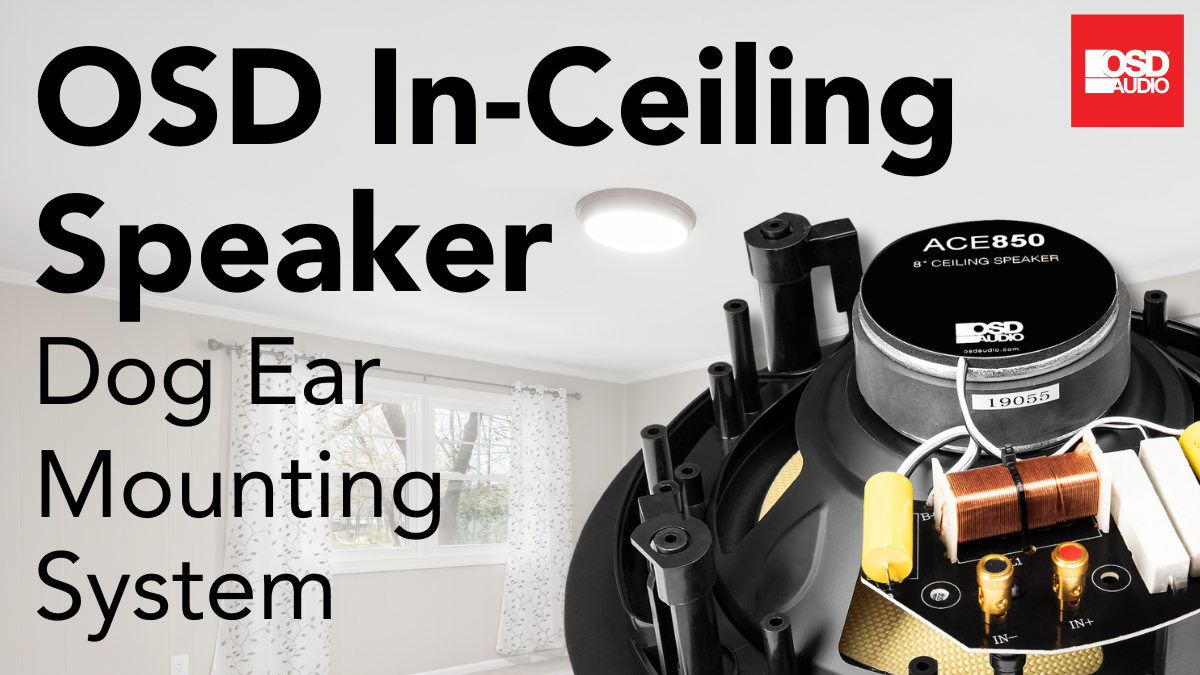
    How Does this Speaker Mount in the Ceiling?
    Customers often ask us if they need special installation mounting brackets on their OSD ceiling speakers. The answer is no and here’s why. All our in-ceiling speakers feature a dog leg (L-shaped) mounting system that is part of the frame. Before you install the speakers, remove the grille and you’ll see several the mounting screws near the front frame. These screws need to be loosened to activate the dog leg clamps. Use a screwdriver to loosen (turn to the left) these screws and the clamp will come loose. When the speaker is in position in the ceiling, tighten (turn to the right) the screw and the speaker will be secured to the ceiling.

    What Type of Speaker Wire and What Gauge?
    Wiring is not included with in-ceiling speakers so you will have to purchase some. We recommend our OSD Audio CL3/FT4 cable that is UL (fire) rated for in-wall and outdoor speaker installs. This type of cable includes a heavy-duty outer jacket approved for in-wall/in-ceiling installation. The high-quality plastic jacket is also very flexible so it's easy to run the wires inside the wall. As for the gauge, for runs up to 100 feet for background music, 16-gauge will be fine. If the run is approaching or exceeding 100 feet, we suggest 14-gauge wire.

    Testing the Sound Quality of In-Ceiling Speakers
    Many customers like to test the sound quality of their new OSD Audio in-ceiling speakers before they install them. Keep in mind, however, that these flush-mount speakers are designed to be used in the wall or ceiling. Uninstalled in-wall/in-ceiling speakers will sound weak and tinny because without the proper enclosure (in this case your house wall) the speaker can’t produce the sound pressure level it needs. If you want to try them out, we recommend mounting the in-ceiling speakers into a box of about 3 cubic ft. or larger; or simply mount them in the ceiling and then listen. This will give you an accurate measure of the sound quality.

    For a retrofit installation, no construction bracket is needed.


    Warning: California's Proposition 65

    Warning:  

    This product can expose you to chemicals, including vinyl chloride, which is known to the State of California to cause cancer. For more information, go to www.P65Warnings.ca.gov.

    • Speaker Type: 8" Weather Resistant Indoor/Outdoor Ceiling Speaker w/ Built-in Crossover
    • Woofer: 8" Fiber Glass Cone with Santoprene Surround
    • Tweeter: 1" Pivoting Titanium Dome
    • Frequency Response: 38Hz-20kHz
    • Power Handling: 150W
    • Sensitivity: 90 dB
    • Impedance: 8 Ohms
    • Weather-resistant for High Moisture Situations
    • Perfect for Outdoor or Indoor Use
    • Spray Paintable Rust-Resistant Aluminum Grille Included
    • Inputs: Gold-plated 5-way Binding Posts
    • Install-friendly Dog Ear Installation Brackets
    • See New Construction Brackets For Compatibility
    • Diameter & Depth: 10.24" x 4.13"
    • Cutout Diameter: 9.06"
    • Sold As: Pair
    • Warranty: 10 Years
    12 Questions asked
    Have a Questions?

    What's on your mind?


    Philip Lusan • 05/16/2023, 10:37:51 AM What size new construction bracket do I need for the ICE840WRS and the ACE840?
    Customer Service • 06/05/2023, 5:49:31 PM
    Hi Philip: The BK-NC8 works for both. I finally emailed you the revised quote by email. TL
    Lee • 06/22/2026, 1:14:49 PM I'm planning to get 4 of these for a covered deck area that is 21' x 20'. The ceiling is 12"x12" joists on 16" centers. That makes the joist area 12" x 16" x 22 feet long. There will be a pair of speakers sharing the same joist space. The roof is metal. Should I build boxes in the joist space for these to be moved in? Or will does their design not require it? If boxes are recommended, should they be insulated? What will provide the best sound? Thanks!
    Customer Service • 06/26/2026, 1:23:19 PM
    Hi Lee: The OSD ICE840WRS is actually one of the better candidates for an open-ceiling installation. It uses an 8" polypropylene woofer with a Santoprene surround, which is designed to work well in a large "infinite baffle" air space. It does not require a sealed enclosure to perform properly. Given your construction, here's what I would recommend. Your Ceiling Construction Covered deck: 21' × 20' 12" × 12" beams on 16" centers Metal roof Four ICE840WRS speakers Two speakers sharing each 22-foot joist cavity My Recommendation I would not build small sealed back boxes. The cavity between your beams is enormous—roughly 30 cubic feet per joist bay (12" × 16" × 22'). That's far larger than any enclosure you could reasonably build and behaves like an infinite baffle, which is what these speakers were designed for. What I would do 1. Separate each pair of speakers Since two speakers share the same joist cavity, install a simple partition halfway between them. A piece of ¾" plywood or OSB sealed around the edges is sufficient. This prevents one woofer from affecting the other and usually results in tighter, cleaner bass. 2. Add insulation Because you have a metal roof, I'd definitely install insulation above the ceiling. I recommend placing unfaced fiberglass or mineral wool batts above the speakers. Benefits include: Reduces rain noise on the metal roof. Lowers heat transfer. Absorbs rear-wave reflections. Reduces cavity resonance. You don't need to pack insulation tightly around the speaker—just allow it to rest naturally above the ceiling. 3. Brace the ceiling A metal roof can transmit vibration. If possible, add blocking or cross-bracing around each speaker location. This stiffens the ceiling and reduces rattles at higher volumes. I would not recommend Small ½ cubic foot MDF back boxes. Tiny "can" enclosures. Foam back cups.Speaker Placement For a 21' × 20' covered deck, four ICE840WRS speakers should provide excellent coverage. I'd place them approximately: 21' R L L R 20' Keep each speaker about 4–5 feet in from the edges and space them evenly. Since they're under a covered patio where people move around, it's generally better to distribute the speakers rather than cluster them in the corners. You'll get more uniform sound at lower volume, which is more pleasant for conversations. My "ideal" installation If this were my project, I'd build it like this: ✔ Leave the joist cavity open (no sealed back boxes) ✔ Install a partition between each pair of speakers ✔ Install R-19 or R-30 unfaced fiberglass or mineral wool above the speakers ✔ Use 14 AWG oxygen-free copper speaker wire ✔ Add blocking around each speaker cutout to stiffen the ceiling I think you'd be very pleased with the results. One additional question: Is the ceiling finished with tongue-and-groove wood (such as cedar or pine), beadboard, or another material? The finish material affects how much reinforcement I'd recommend around each speaker opening. TimL, OSD Consulting ext 104